One of the first questions people ask when considering rooftop solar is:
“How many kW of solar do I need for my home?”
The answer is not the same for every household.
A small home with low electricity consumption may need only a 2 kW solar system, while a larger home with air conditioners, refrigerators, water pumps, and other appliances may require 5 kW, 8 kW, or more.
The right solar system size mainly depends on your electricity consumption, available rooftop space, budget, and how much of your electricity usage you want solar to cover.
In this article, we’ll understand how to estimate the right solar capacity for a home in simple terms.
First, Understand Your Electricity Consumption
Before deciding the size of your solar system, look at your electricity bills.
Your electricity bill normally shows your monthly consumption in units.
Remember from our previous article:
1 unit of electricity = 1 kWh
For example, if your monthly electricity consumption is:
300 units/month
that means your home consumed approximately:
300 kWh/month
This is the starting point for estimating your solar requirement.
How Much Electricity Can a Solar System Generate?
A solar system’s generation depends on several factors, including:
- Solar system capacity
- Location
- Sunlight availability
- Season
- Panel orientation
- Panel tilt
- Shading
- Temperature
- Dust and cleanliness
- Inverter efficiency
- System losses
Therefore, a 5 kW solar system does not produce exactly 5 kWh every hour.
Solar production changes throughout the day.
For a rough estimate, a rooftop solar system in India may produce around 3.5–5 units per kW per day on average, depending on location and conditions.
This is only a planning estimate. Actual generation can be higher or lower.
A Simple Formula to Estimate Solar Capacity
A useful starting point is:
Required Solar Capacity ≈ Monthly Electricity Consumption ÷ Monthly Generation per kW
For a rough calculation, we can assume approximately:
1 kW solar → around 100–150 units/month
The actual figure varies by location and season.
Let’s use a middle-of-the-range planning value of approximately 120 units per month per kW for our examples.
Example 1: Home Using 150 Units per Month
Suppose your electricity bill shows:
150 units/month
If 1 kW of solar produces roughly 120 units per month on average:
150 ÷ 120 = 1.25 kW
A practical system size might therefore be around:
1.5 kW
However, the final size should also consider inverter options, available roof space, future electricity consumption, and local rules.
Example 2: Home Using 300 Units per Month
Suppose your home consumes:
300 units/month
Using the same rough estimate:
300 ÷ 120 = 2.5 kW
So a system around:
2.5–3 kW
could be considered as a starting point.
A 3 kW system may generate roughly 300–450 units per month under suitable average conditions, but actual generation will vary significantly.
Example 3: Home Using 500 Units per Month
Suppose your household consumes:
500 units/month
Then:
500 ÷ 120 ≈ 4.17 kW
A practical choice might be around:
4–5 kW
depending on your electricity usage pattern and how much of your consumption you want to offset.
Example 4: Home Using 700 Units per Month
For a household consuming:
700 units/month
the rough calculation is:
700 ÷ 120 ≈ 5.8 kW
So you might consider a system around:
6 kW
Again, this is an initial estimate rather than a final system design.
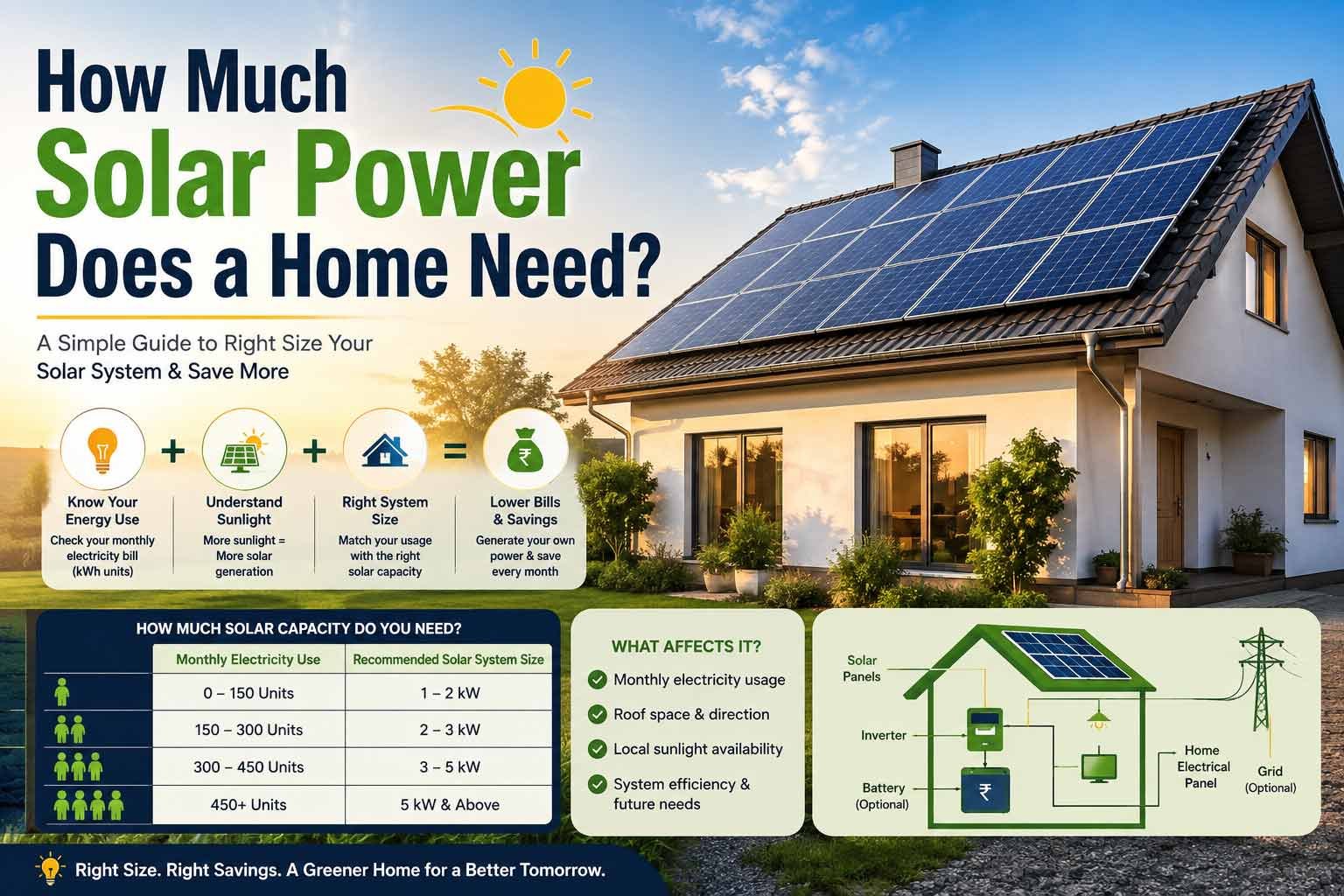
Quick Solar Sizing Guide
Here is a simple reference table:
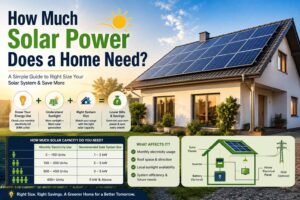
| Monthly Consumption | Approx. Solar Size |
|---|---|
| 100 units | 1–1.5 kW |
| 150 units | 1.5 kW |
| 200 units | 1.5–2 kW |
| 300 units | 2.5–3 kW |
| 400 units | 3–4 kW |
| 500 units | 4–5 kW |
| 600 units | 5 kW |
| 700 units | 5–6 kW |
| 1,000 units | 7–9 kW |
Important: These are rough planning ranges, not guaranteed generation figures. The actual requirement should be calculated using your location’s solar resource, historical electricity consumption, roof conditions, system losses, and applicable utility rules.
Don’t Size Solar Based Only on Your Highest Electricity Bill
Suppose your electricity consumption looks like this:
- January: 250 units
- February: 270 units
- March: 290 units
- April: 350 units
- May: 500 units
- June: 550 units
- July: 450 units
- August: 400 units
- September: 330 units
- October: 300 units
- November: 280 units
- December: 260 units
If you simply look at the highest bill, you might choose a very large solar system.
A better approach is to examine 12 months of electricity consumption.
Calculate your total annual consumption and average monthly consumption.
This gives you a much better picture of your actual energy needs.
Consider Future Electricity Consumption
Your electricity usage may increase in the future.
For example, today you may have:
- 2 fans
- 1 refrigerator
- 1 TV
- LED lights
- 1 washing machine
But you may later add:
- Air conditioner
- Water heater
- Water pump
- Additional refrigerator
- Electric oven
- Computer
- Electric vehicle
Your electricity consumption could increase significantly.
Therefore, don’t always design a system only for today’s consumption.
If you expect your electricity usage to increase, it may make sense to consider that when planning the solar system.
However, installing a much larger system than you need can also increase the initial cost without providing proportional benefits.
What About Air Conditioners?
Air conditioners can significantly increase household electricity consumption.
For example, suppose an AC averages approximately 1.2 kW while operating.
If it runs for 6 hours:
1.2 kW × 6 hours = 7.2 kWh
That’s approximately:
7.2 units per day
Over 30 days:
7.2 × 30 = 216 units
This is only an example. Actual AC consumption depends on its capacity, efficiency, temperature setting, outdoor temperature, compressor operation, and usage pattern.
This shows why adding an AC can substantially change your solar requirement.
What About a Water Pump?
Water pumps can also contribute to electricity consumption.
Suppose a pump uses:
1 kW
and runs for:
1 hour per day
Then its approximate daily consumption is:
1 kW × 1 hour = 1 kWh
That’s approximately:
1 unit per day
or around:
30 units per month
Again, actual consumption depends on the pump’s actual electrical input and operating time.
Solar System Size vs Electricity Consumption
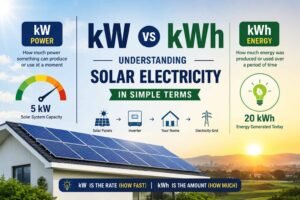
It is important to understand that:
Solar system size ≠ monthly electricity consumption
For example:
5 kW solar system
is a measure of power capacity.
While:
500 kWh/month
is a measure of energy consumption.
You need to compare the expected energy generation from your solar system with your household’s energy consumption.
That’s why understanding kW vs kWh is important before selecting a solar system.
How Much Roof Space Is Required?
Solar panels also require sufficient rooftop space.
The exact area depends on the panel wattage and physical dimensions.
For example, modern rooftop panels may commonly have capacities around 450–600 W or more.
A 5 kW system could therefore require roughly:
9–12 panels
depending on the panel wattage.
For example:
Using 550 W panels
5,000 W ÷ 550 W ≈ 9.1
So you would need approximately:
10 panels
A 550 W panel is typically around 2–2.5 square metres in physical area, though dimensions vary by manufacturer.
After allowing space for mounting structures, maintenance access, setbacks, and the actual roof layout, the total required rooftop area will be greater than simply adding the panel areas.
South-Facing Roof Is Not the Only Consideration
Many people assume that a solar system can only be installed on a perfectly south-facing roof.
In reality, solar system design depends on your location and roof orientation.
The designer should consider:
- Roof direction
- Roof angle
- Shading
- Nearby buildings
- Trees
- Water tanks
- Other structures
- Panel layout
- Maintenance access
Even a small amount of shading on part of a solar array can affect its performance, depending on the system design and equipment used.
A professional site assessment is therefore important before finalizing the installation.
Should You Install a Solar System Equal to Your Entire Consumption?
Not necessarily.
Your goal might be to offset:
50% of your electricity consumption or 80% or almost all of your annual consumption
The ideal system depends on your objective.
For example, if your home consumes 500 units per month, you don’t necessarily have to install a system that generates exactly 500 units every month.
Solar generation changes from month to month.
A system may produce more electricity during months with better sunlight and less during rainy or cloudy periods.
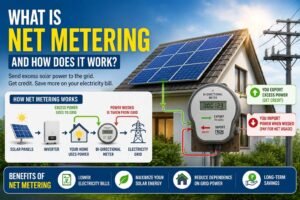
For grid-connected systems, electricity import and export arrangements also depend on your local utility’s rules.
Why Monthly Generation Changes
A solar system can produce different amounts of electricity in different months.
For example:
| Month | Possible Generation Trend |
|---|---|
| January | Moderate |
| February | Good |
| March | Good |
| April | High |
| May | High |
| June | Variable |
| July | Variable/Lower in cloudy weather |
| August | Variable |
| September | Moderate |
| October | Good |
| November | Good |
| December | Moderate |
The exact pattern depends heavily on your location and local weather.
This is why a solar system should ideally be evaluated on an annual energy basis, rather than expecting the same number of units every month.
What Size Solar System Is Suitable for a Typical Home?
There is no single answer, but these broad categories can help beginners understand the scale.
1–2 kW
Suitable for smaller households with relatively low electricity consumption.
3 kW
A common size for a small-to-medium household with moderate electricity consumption.
5 kW
Suitable for many larger homes with higher consumption, particularly where there are multiple appliances and air-conditioning loads.
6–10 kW
May be appropriate for larger homes or households with high electricity consumption.
The correct size should always be determined from actual consumption and site conditions rather than choosing a size simply because it is popular.
What If Your Electricity Consumption Is Very Low?
Suppose your home consumes only:
80–100 units per month
Installing a very large solar system may not make economic sense.
A smaller system may be more appropriate.
The objective should be to balance:
Electricity consumption + solar generation + system cost + available roof space
rather than simply installing the biggest system possible.
What If Your Electricity Consumption Is Very High?
If your home consumes:
800–1,000+ units per month
you may need a larger solar system.
However, you should also look at why your electricity consumption is high.
Improving energy efficiency can reduce the required solar capacity.
For example:
- Use energy-efficient appliances
- Choose higher-efficiency air conditioners
- Replace inefficient lighting
- Reduce unnecessary standby consumption
- Improve insulation where practical
- Use appliances efficiently
Reducing electricity consumption and generating solar power work well together.
A Better Way to Calculate Your Solar Requirement
For a more accurate estimate, follow these steps.
Step 1: Collect your electricity bills
Ideally collect 12 months of bills.
Step 2: Record monthly consumption
Write down the number of units consumed each month.
Step 3: Calculate annual consumption
Add all 12 months together.
Step 4: Calculate average monthly consumption
Divide annual consumption by 12.
Step 5: Check your roof
Look at:
- Available area
- Direction
- Shading
- Roof structure
- Panel placement
Step 6: Estimate local solar generation
Use realistic generation estimates for your location rather than a generic number.
Step 7: Decide your target
Do you want solar to offset:
- Part of your electricity?
- Most of it?
- Nearly all of your annual consumption?
Step 8: Select the system
Based on these factors, determine an appropriate solar capacity.
Don’t Forget the Inverter
Solar panels and the inverter are not exactly the same thing.
For example, you might have a solar array with a certain panel capacity and an inverter with a particular AC output rating.
The final design depends on the inverter manufacturer’s specifications, panel configuration, local conditions, and applicable installation standards.
Therefore, don’t select panels and inverter independently without considering how they work together.
What Happens If You Install Too Small a System?
Suppose your home consumes 600 units per month but your solar system only offsets a relatively small portion of that consumption.
You will continue buying a significant amount of electricity from the grid.
That doesn’t necessarily mean the solar system is bad—it simply means it isn’t large enough to cover most of your consumption.
A smaller system can still make sense if your budget or roof space is limited.
What Happens If You Install Too Large a System?
A very large system can also be inefficient from a financial perspective.
You may spend more money upfront, require more roof space, and potentially generate more electricity than you can effectively use or offset under the applicable grid/export arrangement.
Therefore:
The biggest solar system is not always the best solar system.
The goal is to find the right-sized system for your actual needs.
A Simple Rule for Beginners
If you’re just starting to explore rooftop solar, remember these three steps:
1. Check your electricity consumption in units (kWh).
2. Estimate how much energy 1 kW of solar can generate at your location.
3. Choose a system size that reasonably matches your annual electricity needs and goals.
For example:
300 units/month → roughly 2.5–3 kW
500 units/month → roughly 4–5 kW
700 units/month → roughly 5–6 kW
These are only starting points. A proper system design should use your actual consumption data and local solar conditions.
Conclusion
Choosing the right solar system size is not simply about looking at your electricity bill and picking a number.
You need to consider your monthly and annual electricity consumption, future energy needs, roof space, sunlight, shading, budget, and grid connection arrangements.
For many homes, a system in the 2–5 kW range can be a useful starting point for evaluation, while larger households may need more.
The most important thing is to avoid both undersizing and oversizing.
A well-designed solar system should be sized according to your actual energy requirements and the conditions of your home.
And remember the key difference:
kW tells you the size or power capacity of the solar system, while kWh tells you how much electricity it actually generates or your home consumes.
Once you understand that, choosing a rooftop solar system becomes much easier.
Frequently Asked Questions
How many kW of solar does a normal house need?
There is no universal size. A small household may need around 1–2 kW, while a larger household may require 5 kW or more. Your electricity consumption should be the starting point.
Is 3 kW solar enough for a house?
It can be enough for a household with moderate electricity consumption. Whether it is sufficient depends on your monthly usage, location, roof conditions, and how much of your electricity you want to offset.
Is 5 kW solar enough for a house?
A 5 kW system can be suitable for many medium-to-large homes, but the actual suitability depends on electricity consumption and local solar conditions.
How many units can a 5 kW solar system generate?
A 5 kW system may generate roughly 15–25 units per day under favorable conditions, but actual generation varies by location, season, weather, shading, panel orientation, and system losses.
Can I install a larger solar system than I currently need?
Technically, this may be possible depending on your roof, electrical system, inverter, utility rules, and applicable regulations. However, oversizing may not always be economically beneficial.
Should I calculate solar requirements using one month’s electricity bill?
It is better to use at least 12 months of consumption data because electricity usage and solar generation both change throughout the year.