If you are planning to install a solar system or have already installed one, you have probably come across terms like kW, kWh, W, and units of electricity.
At first, these terms can be confusing. For example, a solar panel may be rated at 550 W, your inverter may be rated at 5 kW, and your electricity bill may show that you consumed 250 units in a month.
So, what exactly is the difference between kW and kWh?
The easiest way to remember it is:
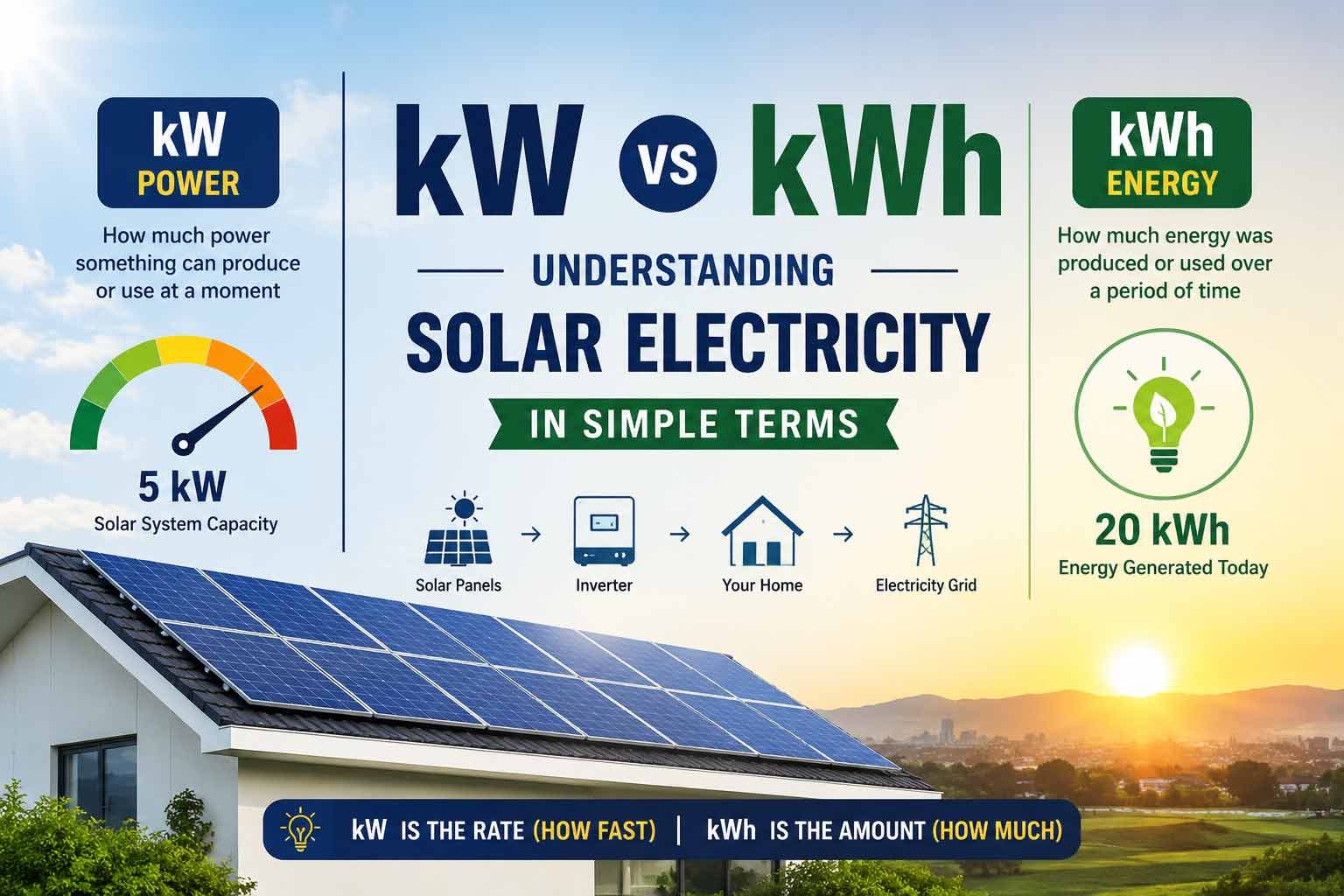
kW tells you how much power something can produce or use at a particular moment. kWh tells you how much energy was produced or used over a period of time.
Let’s understand this with simple examples.
What Is kW?
kW stands for kilowatt.
It is a unit of power.
Power tells us the rate at which electrical energy is being produced or consumed.
1 kW = 1,000 watts
For example:
- 100 W LED bulb = 0.1 kW
- 1,000 W heater = 1 kW
- 2,000 W appliance = 2 kW
- 5,000 W solar inverter = 5 kW
If your rooftop solar system has a capacity of 5 kW, it means the system can produce power at a rate of up to approximately 5 kW under suitable conditions.
It does not mean that the system produces 5 kWh of electricity every hour regardless of the weather.
Solar production changes throughout the day depending on sunlight, temperature, panel orientation, shading, and other factors.
What Is kWh?
kWh stands for kilowatt-hour.
It is a unit of energy.
While kW describes the rate of power, kWh tells us the total amount of energy produced or consumed over time.
For example, if a 1 kW appliance runs continuously for 1 hour:
1 kW × 1 hour = 1 kWh
Therefore:
1 kWh = 1 unit of electricity
This is the “unit” that you commonly see on your electricity bill.
Simple examples
If a 1 kW appliance runs for:
- 1 hour → 1 kWh
- 2 hours → 2 kWh
- 5 hours → 5 kWh
- 10 hours → 10 kWh
Similarly, a 500 W appliance (0.5 kW) running for 4 hours consumes:
0.5 kW × 4 hours = 2 kWh
So it consumes 2 units of electricity.
kW vs kWh: The Simple Difference
A simple way to remember the difference is:
| Term | Meaning | Example |
|---|---|---|
| W | Watt | 550 W solar panel |
| kW | Kilowatt — power | 5 kW solar inverter |
| kWh | Kilowatt-hour — energy | 20 kWh solar generation |
| Unit | Common electricity-bill term for kWh | 20 units |
Think of it this way:
kW = how fast
kWh = how much
For example, a car’s speedometer tells you how fast the car is moving, while the odometer tells you how far it has travelled.
Similarly:
kW is like speed.
kWh is like distance travelled.
This is not a perfect physical analogy, but it is an easy way for beginners to remember the difference.
How Does This Apply to Solar Panels?
Suppose you have a rooftop solar system with 5 kW of installed capacity.
The “5 kW” refers to the power rating of the solar system.
But the amount of electricity it generates during a day is measured in kWh.
For example, on one particular day, your solar monitoring system might show:
Solar generation = 20 kWh
That means your solar system generated approximately 20 units of electricity that day.
The next day, it might generate only 17 kWh because of clouds or rain.
Another day might produce 22 kWh because of better sunlight.
Therefore:
A 5 kW solar system does not necessarily generate 5 kWh every hour.
Its actual energy generation depends on the available sunlight and system conditions.
A Simple Example of a 5 kW Solar System
Let’s imagine a house has a 5 kW rooftop solar system.
During the day, the solar panels generate electricity.
The power generated may look something like this:
Morning: Low generation
Late morning: Generation increases
Around midday: Generation reaches its highest level
Afternoon: Generation decreases
Evening: Solar generation approaches zero
So, although the system has a 5 kW capacity, it does not continuously produce 5 kW throughout the entire day.
If the system generates a total of 20 kWh during the day, that is the total energy produced.
In simple terms:
Installed capacity = 5 kW
Daily generation = 20 kWh
Why Doesn’t a 5 kW Solar System Produce 5 kWh Every Hour?
This is one of the most common questions among new solar users.
A 5 kW solar system can reach around 5 kW of instantaneous output under favorable conditions, but solar output is constantly changing.
For example, early in the morning, sunlight is weak, so the system may produce only a small amount of power.
Around midday, when sunlight is stronger, production may be much higher.
Clouds, rain, dust, temperature, shading, panel direction, and other factors can also reduce output.
Therefore, the total daily energy is measured in kWh, not simply by multiplying the system’s kW rating by 24 hours.
Understanding Solar Generation in kWh
Suppose your solar monitoring application shows:
Today’s generation: 18.5 kWh
This means your solar system generated 18.5 units of electricity today.
If your system generates:
- 18 kWh today
- 20 kWh tomorrow
- 17 kWh the next day
then the three-day generation is:
18 + 20 + 17 = 55 kWh
So the solar system generated 55 units during those three days.
kW and kWh in an On-Grid Solar System
For an on-grid solar system, understanding kW and kWh is particularly useful.
Your solar system has a certain capacity, such as:
- 2 kW
- 3 kW
- 5 kW
- 10 kW
This is the system’s power capacity, measured in kW.
Your electricity meter, however, measures the amount of electrical energy consumed from or supplied to the grid over time, measured in kWh.
For example, imagine your house has a 5 kW solar system.
During the day:
Solar generation → 15 kWh
Your home consumes:
10 kWh
The remaining energy may be exported to the electricity grid, depending on your system and local net-metering arrangement.
In this simplified example:
Solar generation = 15 kWh
House consumption = 10 kWh
Potential surplus = 5 kWh
The actual amount exported depends on the instantaneous generation, household load, meter behavior, and applicable electricity regulations.
What Does “Unit” Mean on an Electricity Bill?
When your electricity bill says that you consumed 300 units, it generally means:
300 kWh
Because:
1 unit = 1 kWh
So:
100 units = 100 kWh
250 units = 250 kWh
500 units = 500 kWh
This is why kWh is very important when calculating your electricity consumption and solar generation.
Example: Calculate Electricity Consumption
Suppose you have a 1,000 W air conditioner or appliance.
1,000 W = 1 kW
If it operates for 5 hours:
Energy = Power × Time
Energy = 1 kW × 5 hours
Energy = 5 kWh
Therefore, it consumes approximately 5 units of electricity during those 5 hours if it actually operates at a constant 1 kW.
Real appliances may not consume their rated power continuously, so actual consumption can be different.
Another Example: A 100 W Fan
Suppose a fan consumes approximately 100 W.
Convert watts to kilowatts:
100 W ÷ 1,000 = 0.1 kW
If the fan runs for 10 hours:
0.1 kW × 10 hours = 1 kWh
Therefore, it consumes approximately:
1 unit of electricity
Again, actual consumption can vary depending on the fan and its operating conditions.
Why Solar Users Should Understand kWh
If you own a solar system, kWh is one of the most useful numbers to monitor.
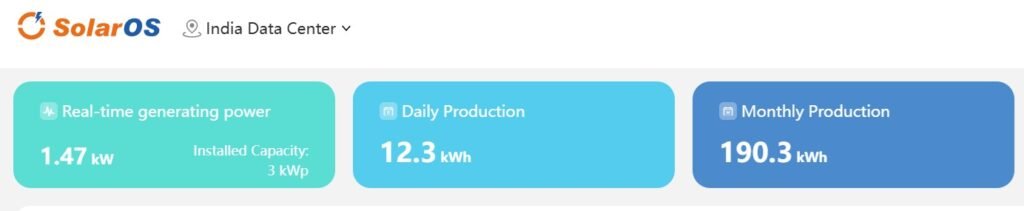
Your solar monitoring app may show values such as:
- Current power: 3.2 kW
- Today’s generation: 18.7 kWh
- Monthly generation: 450 kWh
- Total lifetime generation: 5,200 kWh
These numbers mean different things.
Current power — 3.2 kW
The solar system is currently producing approximately 3.2 kW of power.
Today’s generation — 18.7 kWh
The system has generated approximately 18.7 units of energy since the beginning of the day.
Monthly generation — 450 kWh
The system generated approximately 450 units during the month.
Lifetime generation — 5,200 kWh
The system has generated approximately 5,200 units since it was installed.
What Does a 550 W Solar Panel Mean?
You may see solar panels advertised as:
550 W solar panel
This means the panel has a rated power of approximately 550 watts (0.55 kW) under specified test conditions.
It does not mean the panel generates 550 kWh per day.
For example, if a 550 W panel produces an average of 0.55 kW for the equivalent of 4 hours of full-output sunlight:
0.55 kW × 4 hours = 2.2 kWh
That would be approximately 2.2 units of energy.
However, actual daily generation varies significantly depending on location, season, weather, temperature, shading, panel orientation, inverter losses, and other factors.
kW vs kWh: An Easy Real-Life Analogy
Imagine a water pipe.
kW is like the rate at which water is flowing through the pipe.
kWh is like the total amount of water collected over a period of time.
If water flows quickly, you have a high flow rate.
If it flows for a long time, you collect more water.
Similarly:
Power (kW) × Time (hours) = Energy (kWh)
This simple relationship is extremely useful for understanding electricity.
The Basic Formula
The most important formula to remember is:
Energy (kWh) = Power (kW) × Time (hours)
For example:
2 kW × 3 hours = 6 kWh
Therefore, using a 2 kW load for 3 hours would consume approximately 6 units of electricity if the load remained at 2 kW.
You can also rearrange the formula:
Power (kW) = Energy (kWh) ÷ Time (hours)
And:
Time (hours) = Energy (kWh) ÷ Power (kW)
Why kW and kWh Are Both Important When Choosing Solar
When installing solar, you will encounter both measurements.
kW is important for:
- Solar panel capacity
- Inverter capacity
- Maximum power output
- Household electrical load
- System sizing
kWh is important for:
- Daily solar generation
- Monthly electricity consumption
- Electricity bills
- Solar savings
- Grid import and export
- Measuring total energy generation
A good solar system design considers both.
You need enough kW capacity to meet the required power demand, while the expected kWh generation should match a meaningful portion of your electricity consumption.
Don’t Confuse kW With kWh
A common mistake is saying:
“My solar system generated 20 kW today.”
Usually, what you mean is:
“My solar system generated 20 kWh today.”
The first statement describes power at a particular moment.
The second describes the total energy generated during the day.
Similarly, your electricity bill does not normally say that you consumed “300 kW” during the month. It would typically be 300 kWh, or 300 units.
Using the correct term makes it much easier to understand solar system performance.
Quick Summary
Let’s summarize everything in a simple way.
kW = Power
It tells you the rate of electricity production or consumption.
kWh = Energy
It tells you the total amount of electricity produced or consumed over time.
1 kW × 1 hour = 1 kWh
And:
1 kWh = 1 unit of electricity
For solar:
Solar system size → kW
Solar energy generated → kWh
Electricity consumed → kWh
Electricity bill units → kWh
Once you understand this difference, solar monitoring, electricity bills, inverter specifications, and solar generation reports become much easier to understand.
Conclusion
If you are new to solar energy, don’t worry if terms like kW and kWh initially seem confusing. The difference is actually quite simple.
Think of kW as the rate and kWh as the amount accumulated over time.
A 5 kW solar system describes the system’s power capacity, while 20 kWh of daily generation describes how much energy the system actually produced that day.
Understanding this small difference will help you make better decisions about solar system sizing, electricity consumption, energy savings, and monitoring your rooftop solar system.
In the next articles in our Solar Technology series, we will continue exploring how rooftop solar systems work, how much electricity they can generate, and how to understand the numbers shown by a solar inverter and electricity meter.