If you have recently installed an on-grid solar system, you may have wondered:
“What happens to my solar panels when the electricity goes off?”
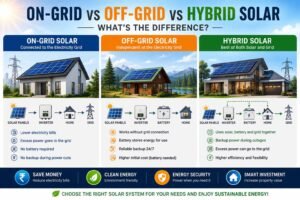
It is a very important question because an on-grid solar system works differently from an off-grid or hybrid solar system.
The surprising answer is that your solar panels usually stop supplying electricity to your home during a power cut—even when the sun is shining brightly.
Why does this happen? The answer is grid safety and anti-islanding protection.
In this article, let’s understand what happens to an on-grid solar system during a power outage, why the inverter shuts down, what happens to the solar panels, and what you need if you want backup power during an outage.
What Is an On-Grid Solar System?
An on-grid solar system, also called a grid-connected solar system, is connected directly to the electricity grid.
A typical system contains:
- Solar panels
- Solar inverter
- AC distribution/protection equipment
- Bidirectional electricity meter
- Connection to the utility grid
- Your home’s electrical loads
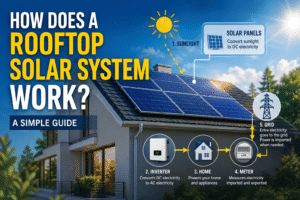
During normal operation, solar energy is used by your appliances first. If your solar system produces more electricity than your home needs, the excess can be exported to the electricity grid, depending on your net-metering or applicable billing arrangement.
When solar production is insufficient, electricity can be drawn from the grid.
So, the system normally works together with the electricity grid.
What Happens When the Grid Power Goes Off?
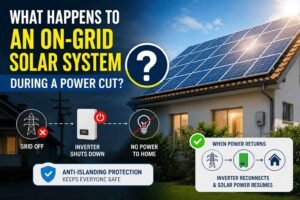
When there is a power cut, the on-grid inverter detects that the utility grid has disappeared.
It immediately stops supplying AC power to your home.
This means:
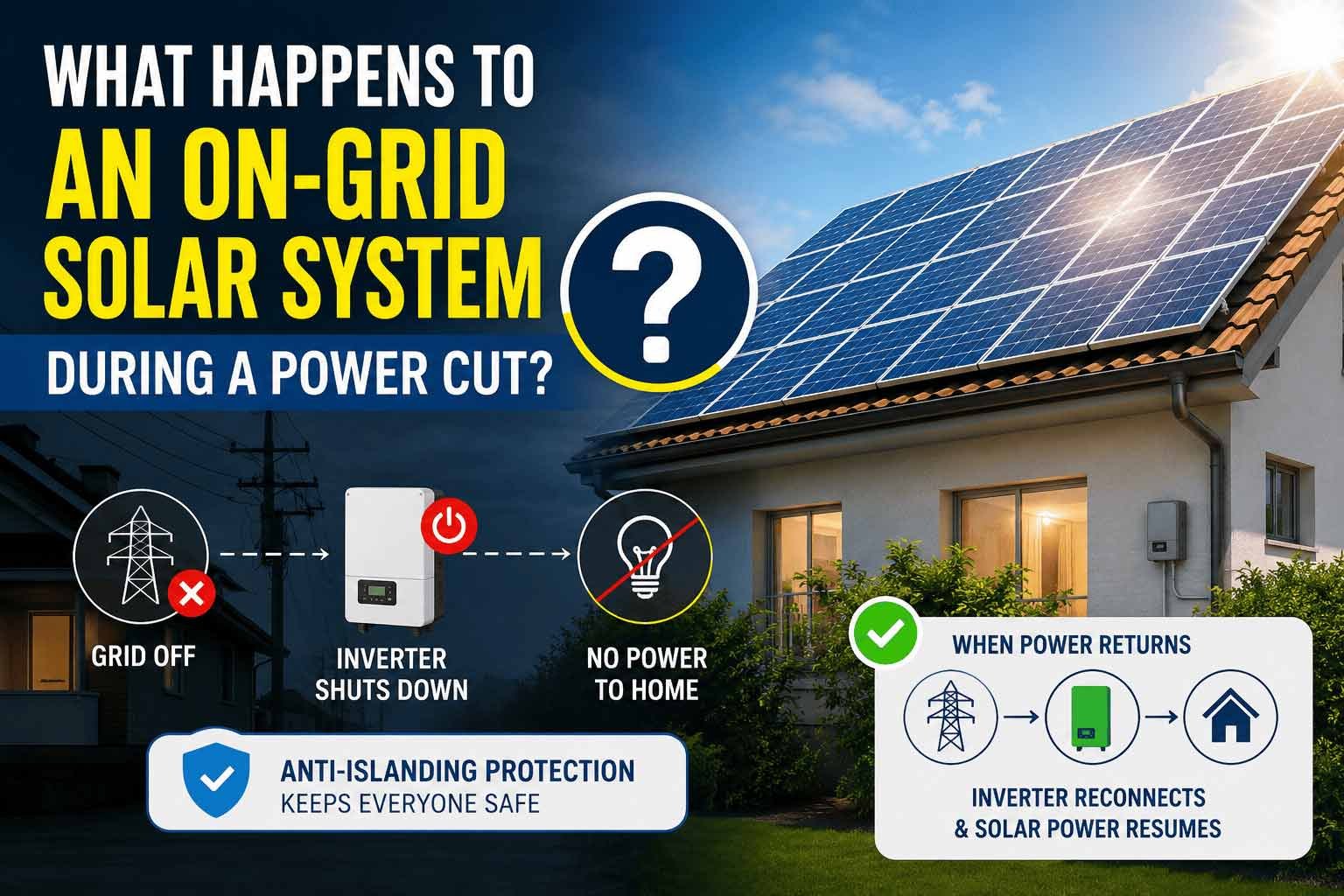
Grid OFF → Inverter detects outage → Inverter shuts down → Solar generation to your home stops
Even if your solar panels are receiving strong sunlight, your normal on-grid system will not continue powering your appliances.
This may seem strange at first.
After all, your solar panels are still producing electricity.
So why can’t you use it?
The main reason is safety.
Why Does the Solar Inverter Shut Down?
The primary reason is to protect electricity-line workers.
Imagine that a utility company has disconnected the electricity supply to repair a damaged power line.
The workers naturally expect the line to be electrically dead.
If a customer’s solar system continued feeding electricity into that line, it could create a dangerous situation.
This unwanted condition is known as islanding.
Therefore, grid-connected inverters are designed with anti-islanding protection.
When the inverter detects abnormal grid conditions or a grid outage, it disconnects itself from the grid.
This prevents your solar installation from unintentionally energizing the utility network.
What Is Anti-Islanding Protection?
Anti-islanding protection is a safety feature built into grid-connected solar inverters.
Under normal conditions:
Solar panels → Inverter → Home + Grid
During a power cut:
Solar panels → Inverter → Shutdown
The inverter continuously monitors the grid for parameters such as voltage and frequency.
If the grid disappears or conditions move outside the permitted operating range, the inverter stops its grid-connected operation.
This is one of the most important safety features of an on-grid solar system.
Do Solar Panels Stop Producing Electricity?
This is an important distinction.
The solar panels themselves may still receive sunlight and generate DC electricity.
However, the on-grid inverter does not convert and supply that energy to your home’s AC electrical system while the grid is unavailable.
So you can think of it this way:
Sunlight is available → Panels can generate DC power → Grid is unavailable → Inverter disconnects → Home does not receive solar power
The panels aren’t necessarily “dead.” The system simply cannot operate in its normal grid-connected mode.
What Happens to Your Home Appliances?
During a power cut, appliances connected to your normal household electrical supply will lose power just as they would with a conventional electricity connection.
For example:
- Lights will go off.
- Fans will stop.
- Television will turn off.
- Refrigerator will stop until power returns.
- Wi-Fi router will lose power unless it has a backup.
- Computers will shut down unless connected to a UPS.
Your solar panels will not normally keep these appliances running with a standard on-grid system.
What Happens When Grid Power Returns?
When electricity from the utility grid returns, the inverter does not necessarily start producing power instantly.
It first checks whether the grid conditions are stable and within the required operating limits.
After the required reconnection process, the inverter resumes normal operation.
The system then returns to its normal mode:
Solar panels → Inverter → Home loads
and any surplus generation can again be exported to the grid according to the applicable metering arrangement.
Why Can’t the Inverter Simply Use Solar Power During the Outage?
This is one of the most common questions from new solar owners.
It might seem easy:
“The panels are producing electricity, so why doesn’t the inverter simply send that electricity to my house?”
The problem is that a standard on-grid inverter is designed to operate synchronized with the utility grid.
The grid provides the reference for the AC electrical system.
When the grid disappears, the inverter must disconnect rather than create an independent electrical network.
An inverter designed specifically for backup operation is different.
On-Grid vs Hybrid Solar During a Power Cut
The difference becomes much clearer when comparing system types.
| Feature | On-Grid | Hybrid |
|---|---|---|
| Connected to grid | Yes | Yes |
| Solar panels | Yes | Yes |
| Battery | Usually no | Yes |
| Works during grid outage | Usually no | Yes |
| Backup power | No | Yes |
| Can store solar energy | No battery storage | Yes |
| Anti-islanding protection | Yes | Yes |
An off-grid system is another option, where the system is designed to operate independently of the utility grid.
What If You Want Solar Power During a Power Cut?
If uninterrupted power during outages is important to you, a standard on-grid solar system may not be enough.
You generally need a system designed for backup operation, such as:
1. Hybrid Solar System
A hybrid inverter can work with:
- Solar panels
- Grid electricity
- Batteries
- Home loads
During normal operation, solar power can supply your loads and charge the battery.
During a grid outage, the inverter can isolate the backup circuit from the utility grid and continue supplying selected loads from solar and/or battery power.
2. Battery Backup
A battery stores electricity generated by the solar system.
During a power cut, stored energy can be used to operate selected appliances.
The amount of backup you get depends on:
- Battery capacity
- Solar production
- Appliance load
- Inverter capacity
- Backup duration
3. Separate UPS/Inverter
For smaller backup requirements, you can use a conventional UPS or inverter for essential appliances.
For example, you might keep:
- Wi-Fi router
- Computer
- Lights
- Fans
- CCTV system
running through a separate backup system.
Can a Battery Be Added to an Existing On-Grid System?
Sometimes, yes—but it depends on your existing inverter and system design.
Some solar inverters support battery integration, while many traditional grid-tied inverters do not.
If you want to add backup capability later, you should check:
- Your inverter model
- Whether it supports battery storage
- Compatible battery technology
- Backup output capability
- Required protection equipment
- Wiring and load requirements
Simply connecting a battery to a normal grid-tied inverter is not a safe or valid way to create backup power.
A qualified solar installer should design the system correctly.
Does a Power Cut Affect the Solar Panels?
A normal grid outage does not mean that your solar panels are damaged.
The panels remain physically installed on your roof and can continue receiving sunlight.
The inverter’s protection system simply prevents the solar installation from operating as a normal grid-connected power source while the utility supply is unavailable.
When the grid returns and the system passes its checks, solar generation can resume.
What Happens on a Cloudy Day During a Power Cut?
The same basic rule applies.
Whether the sun is:
- Bright
- Partly cloudy
- Overcast
a standard on-grid inverter will still disconnect when the utility grid goes down.
The amount of sunlight does not change the fundamental grid-safety requirement.
What About Night-Time Power Cuts?
At night, solar panels aren’t generating useful electricity from sunlight.
So an on-grid system naturally depends on the electricity grid at that time.
If you have a battery backup system, however, stored energy can be used during a nighttime outage.
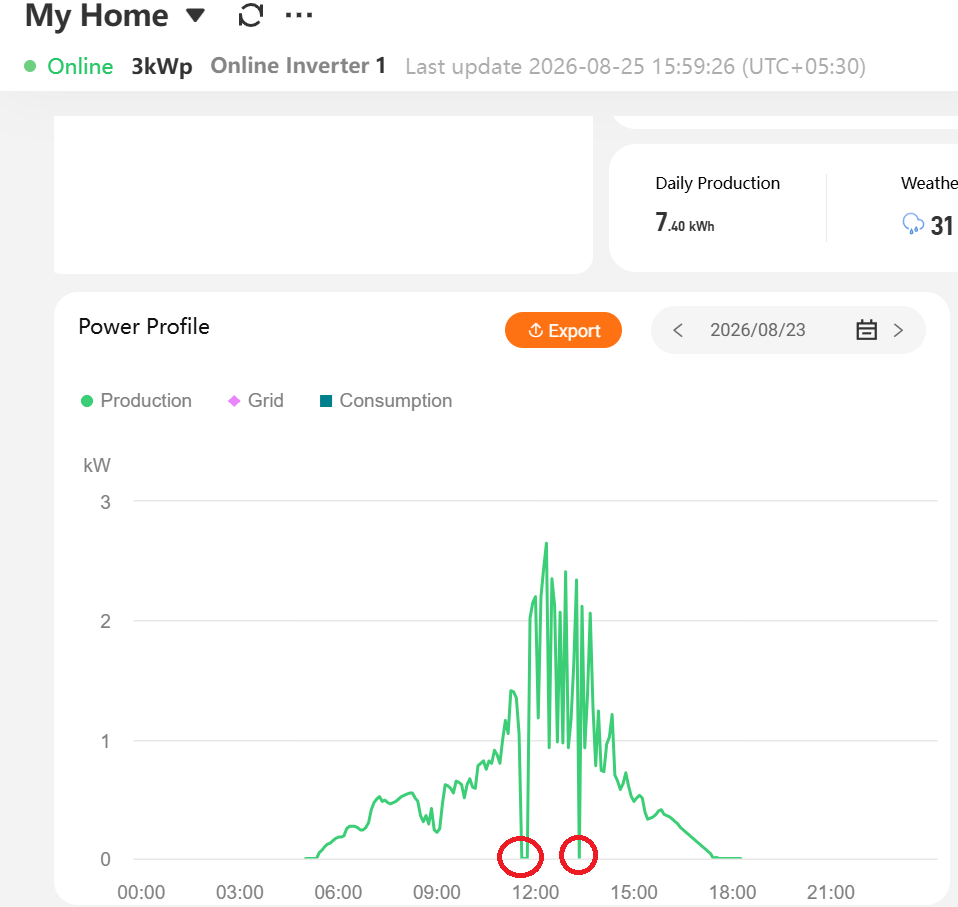
In this graph we can see that the inverter stopped sending electricity two times because of Grid Power cut
Common Misconceptions About On-Grid Solar
Myth 1: “I have solar, so I don’t need electricity during a power cut.”
Not necessarily.
A standard on-grid system normally shuts down when the grid fails.
Myth 2: “My solar panels will power my house if the sun is shining.”
Not with a standard grid-tied setup.
The inverter must disconnect from the grid during an outage.
Myth 3: “The solar panels stop working permanently when there is a power cut.”
No.
The panels can still receive sunlight, but the grid-connected inverter stops normal operation.
Myth 4: “I can install a switch and manually connect solar to my house.”
Do not do this.
Improperly connecting a grid-tied solar system during an outage can create a serious electrical safety hazard.
Backup operation requires properly designed isolation and inverter equipment.
Is an On-Grid Solar System Still Worth It?
Absolutely.
The fact that a standard on-grid system doesn’t provide backup power doesn’t make it a bad choice.
For many homeowners, the primary goals are:
- Reducing electricity bills
- Using clean renewable energy
- Generating electricity during daylight hours
- Exporting surplus electricity to the grid where permitted
- Reducing dependence on grid electricity
If power cuts are frequent in your area and backup power is also important, a hybrid solar system with battery storage may be more suitable.
The right choice depends on your electricity consumption, outage frequency, budget, available roof space, and backup requirements.
A Simple Example
Suppose you have:
3 kW solar panels + grid-tied inverter
At 12 PM on a sunny day, your panels are generating electricity.
Your home is using some of that electricity and the remaining energy may be exported to the grid.
Now imagine the electricity grid suddenly goes down.
The inverter detects the grid failure and disconnects.
Even though the panels are still exposed to strong sunlight, your normal household loads lose power.
When grid electricity returns, the inverter checks the grid and eventually resumes normal operation.
Now imagine the same home has a hybrid inverter + battery.
During the same outage, the hybrid system can isolate the home from the utility grid and supply designated backup loads using the battery and available solar generation.
That is the fundamental difference between a conventional on-grid system and a backup-capable solar system.
Conclusion
If you have a standard on-grid solar system, don’t be surprised when your solar power goes off during a power cut.
It is not necessarily a fault.
It is an important safety feature.
The inverter shuts down because it must not continue feeding electricity into a utility grid that has been disconnected. This protects utility workers and helps prevent dangerous electrical conditions.
If you want your solar system to provide electricity during power outages, you need a properly designed backup solution, such as a hybrid inverter with battery storage or another suitable backup system.
In simple words:
On-Grid Solar + Grid Available = Solar Power Available
On-Grid Solar + Power Cut = Solar Inverter Shuts Down
Hybrid Solar + Battery + Power Cut = Backup Power Possible
Understanding this difference is essential before choosing a solar system for your home.
Frequently Asked Questions
Will my solar inverter work during a power cut?
A standard grid-tied inverter will normally shut down when the utility grid fails.
Will my solar panels still generate electricity?
The panels may still generate DC electricity when exposed to sunlight, but a standard grid-tied system will not normally use that energy to power your home during the outage.
Can on-grid solar work without the grid?
A conventional grid-tied system is designed to operate with the utility grid and will normally shut down when the grid is unavailable.
How can I get solar power during a power cut?
You need a properly designed backup-capable system, such as a hybrid inverter with battery storage, depending on your requirements.
Is the inverter shutting down a problem?
No. The shutdown is an important safety function called anti-islanding protection.