If you are planning to install a solar power system, one of the first decisions you will face is choosing the right type of solar system.
You may come across three common terms:
- On-grid solar
- Off-grid solar
- Hybrid solar
Although all three systems use solar panels to generate electricity, they work differently and are designed for different needs.
The biggest differences are related to the electricity grid, batteries, backup power, and how excess solar electricity is handled.
In this guide, we will explain the differences between on-grid, off-grid, and hybrid solar systems in simple terms so that you can understand which type may be suitable for your home or business.
Quick Comparison
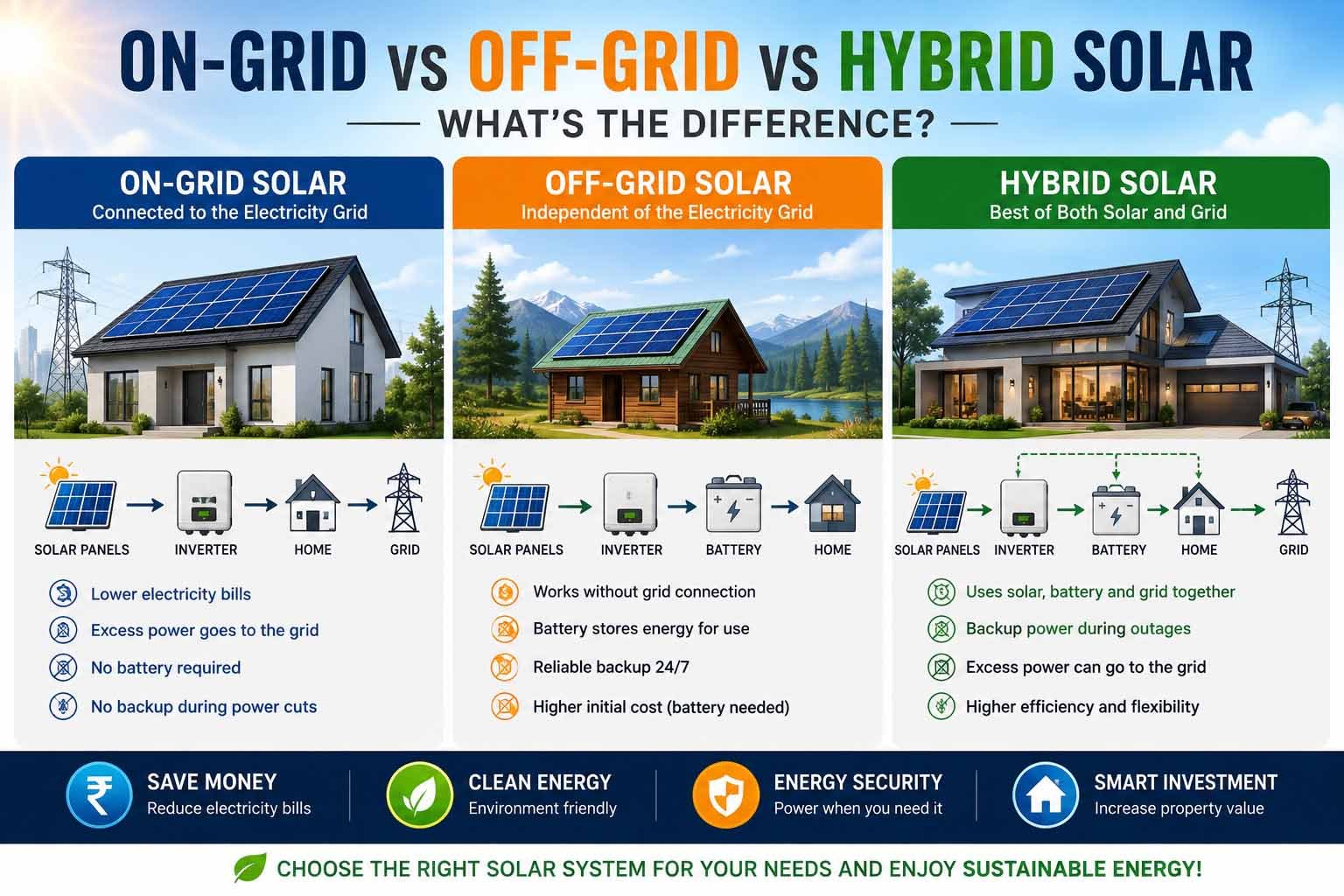
Here is the basic difference at a glance:
| Feature | On-Grid Solar | Off-Grid Solar | Hybrid Solar |
|---|---|---|---|
| Connected to electricity grid | Yes | Usually No | Yes |
| Solar panels | Yes | Yes | Yes |
| Battery | Usually not required | Required | Usually required |
| Works during grid outage | Normally No | Yes | Yes, if backup is configured |
| Can export excess electricity | Yes, where approved | No | Yes, where approved |
| Main energy source | Solar + Grid | Solar + Battery | Solar + Battery + Grid |
| Initial cost | Generally lower | Generally higher | Generally higher |
| Backup capability | Limited | Yes | Yes |
| Suitable for grid-connected homes | Yes | Not usually necessary | Yes |
| Energy independence | Moderate | High | High |
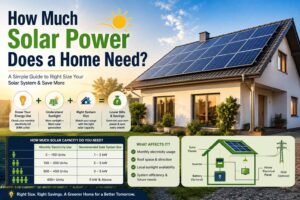
The best system depends on your electricity consumption, grid reliability, budget, roof space, and whether you need backup power.
1. What Is an On-Grid Solar System?
An on-grid solar system, also called a grid-tied solar system, is connected directly to the electricity grid.
The solar panels generate electricity during the day. A grid-connected inverter converts the electricity generated by the panels into AC electricity that can be used by your home.
A simplified flow is:
Solar Panels → Inverter → Home
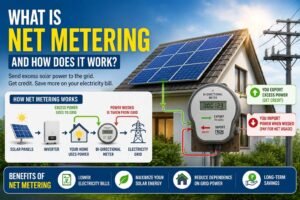
If the solar system generates more electricity than the home is consuming, the surplus can be exported to the electricity grid where the installation is approved for grid export.
When solar generation is insufficient, electricity can be imported from the grid.
Example
Suppose your solar system is generating 4 kW and your home is consuming 2 kW.
Approximately:
2 kW → Home
and the surplus:
2 kW → Grid
Later, when solar generation falls below your household consumption, the grid can supply the difference.
The Biggest Advantage of On-Grid Solar
The major advantage is that you generally don’t need a large battery bank.
The electricity grid works alongside your solar system.
This can make an on-grid system simpler and less expensive than a comparable system with significant battery storage.
The Biggest Disadvantage
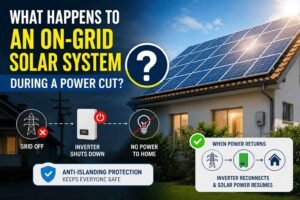
A standard on-grid solar system normally does not provide electricity during a grid outage.
When the electricity grid fails, the grid-tied inverter normally shuts down for safety.
This is known as anti-islanding protection.
Therefore:
An on-grid solar system is primarily designed to reduce grid electricity consumption, not to provide backup power during power cuts.
2. What Is an Off-Grid Solar System?
An off-grid solar system is designed to operate independently of the electricity grid.
Instead of depending on the grid, the system normally uses:
Solar Panels + Inverter + Battery
The solar panels generate electricity during the day, and excess energy can be stored in batteries.
The stored energy can then be used when the sun is unavailable.
A simplified flow is:
Solar Panels → Inverter → Home
and:
Solar Panels → Battery → Home
How Does Off-Grid Solar Work?
During sunny hours, the solar panels generate electricity.
The electricity can be used by appliances while excess generation can charge the battery.
At night, or when solar generation is insufficient, the battery can supply electricity.
For example:
Daytime:
Solar → Appliances
Solar → Battery
Night:
Battery → Appliances
The system therefore does not need the electricity grid for normal operation.
Where Is Off-Grid Solar Useful?
Off-grid solar can be useful in locations where grid electricity is:
- Unavailable
- Difficult to connect
- Very unreliable
- Too expensive to extend
Examples may include:
- Remote houses
- Farms
- Rural buildings
- Remote offices
- Telecommunications sites
- Isolated facilities
The Biggest Advantage of Off-Grid Solar
The biggest advantage is energy independence.
The system can continue supplying electricity even when there is no electricity grid connection.
The Biggest Disadvantage
The biggest challenge is battery storage.
An off-grid system must have enough stored energy to handle periods when solar generation is low.
For example, several cloudy or rainy days can create a significant challenge.
Therefore, an off-grid system needs careful sizing of:
- Solar panels
- Battery capacity
- Inverter
- Daily electricity consumption
- Backup requirements
An incorrectly sized system can result in insufficient power.
3. What Is a Hybrid Solar System?
A hybrid solar system combines solar generation, battery storage, and a grid connection.
It can be thought of as:
On-Grid + Battery Backup
A typical hybrid system may include:
Solar Panels + Hybrid Inverter + Battery + Grid
The system can use solar electricity, charge the battery, import electricity from the grid, and in suitable configurations export electricity to the grid.
How Does Hybrid Solar Work?
During the day, solar electricity can be used by the home.
If there is surplus solar generation, the battery can be charged, depending on the system settings and available capacity.
When solar generation is insufficient, the system can use stored battery energy or electricity from the grid.
During a grid outage, a properly designed hybrid system can continue powering selected loads using the battery and solar generation.
A simplified flow is:
Solar → Home
Solar → Battery
Grid → Home
Battery → Home
and, where approved:
Solar → Grid
This flexibility is the main attraction of a hybrid system.
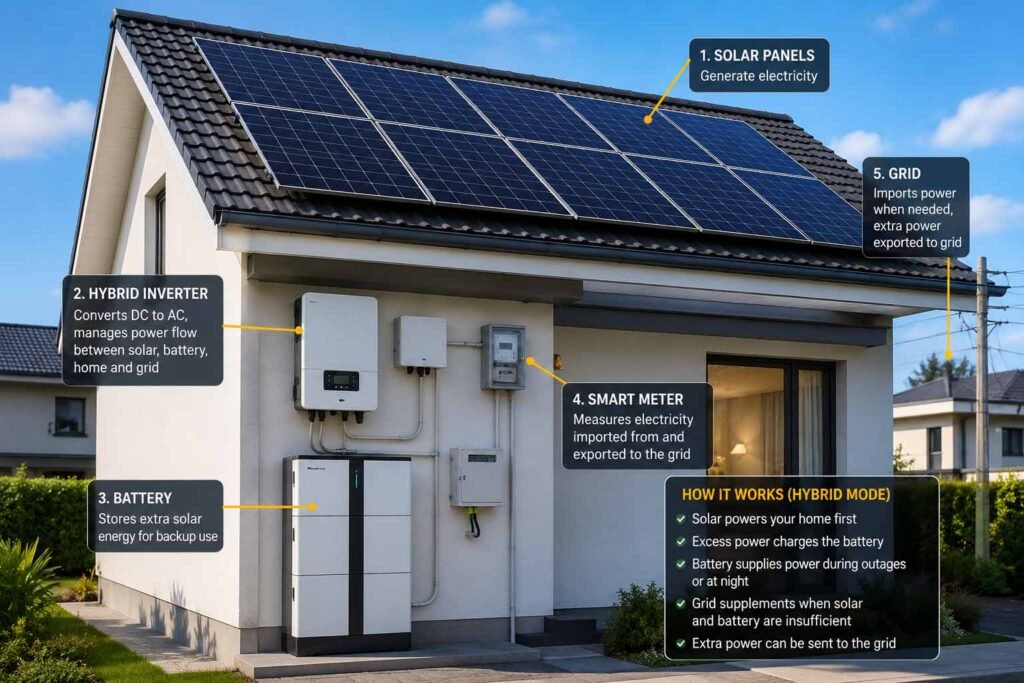
On-Grid vs Off-Grid vs Hybrid: How Electricity Flows
The easiest way to understand the three systems is to look at their energy flow.
On-Grid
Solar → Home
Solar → Grid
Grid → Home
Battery: Usually not required
Off-Grid
Solar → Home
Solar → Battery
Battery → Home
Grid: Normally not connected
Hybrid
Solar → Home
Solar → Battery
Battery → Home
Grid → Home
Solar → Grid, where approved
This makes the hybrid system the most flexible of the three.
What Happens During a Power Cut?
This is one of the most important differences.
On-Grid
A standard grid-tied system normally shuts down when the grid goes off.
Backup: Normally unavailable
Off-Grid
Because the system is designed to operate independently, it can continue supplying electricity from solar and batteries.
Backup: Yes
Hybrid
A properly designed hybrid system can use its battery and solar generation to supply selected loads during a grid outage.
Backup: Yes, if configured for backup operation
However, not every hybrid installation necessarily provides backup to the entire house. The system may be designed to power only selected circuits or essential loads.
What Happens to Excess Solar Electricity?
Another important difference is what happens when your solar panels generate more electricity than you currently need.
On-Grid
Surplus electricity can be exported to the electricity grid when the system is approved for export.
The applicable billing or settlement mechanism depends on local regulations and the electricity distribution utility.
Off-Grid
There is normally no electricity grid to receive the excess.
Instead, surplus solar electricity can be used to charge the battery.
Once the battery is fully charged and household demand is low, additional solar generation may have to be curtailed by the system.
Hybrid
A hybrid system provides more options.
Depending on the system configuration, surplus electricity can be:
Solar → Home
Solar → Battery
Solar → Grid
This flexibility can help optimize how solar energy is used.
Battery Requirements
Battery storage is one of the biggest differences between these systems.
On-Grid
A battery is usually not required.
This keeps the system simpler.
Off-Grid
A battery is essential for most practical systems because there is no grid to supply electricity when solar generation is unavailable.
Hybrid
A battery is normally included when backup capability and energy storage are desired.
Battery size depends on the household’s energy consumption and how much backup is required.
Which System Is More Expensive?
In general:
On-Grid → Lowest initial cost
Hybrid → Higher initial cost
Off-Grid → Can be high depending on battery capacity
However, actual prices vary significantly depending on:
- Solar panel capacity
- Inverter type
- Battery technology
- Battery capacity
- Installation requirements
- Electrical protection
- Roof structure
- Brand and equipment quality
- Local market conditions
Therefore, simply comparing the price of the inverter or solar panels isn’t enough.
Why Are Batteries Expensive?
A battery system adds significant cost because you are not only buying solar generation equipment—you are also purchasing energy storage.
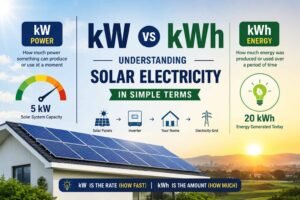
Battery capacity is generally measured in kWh.
For example:
A 10 kWh battery can theoretically store up to around 10 kWh of energy under suitable conditions, although the usable amount depends on the battery’s specifications, allowable depth of discharge, efficiency, operating conditions and system configuration.
Battery storage also has a limited service life and may eventually need replacement.
Which System Has the Lowest Maintenance?
Generally, a basic on-grid system has fewer major components because it does not require a large battery bank.
Therefore:
On-Grid → Generally simpler
Hybrid → More components
Off-Grid → More components and battery management
However, proper maintenance is important for all three systems.
Solar panels should be kept reasonably clean, system performance should be monitored, and electrical equipment should be inspected according to the manufacturer’s recommendations.
Which System Is More Energy Independent?
If we consider independence from the electricity grid:
On-Grid
Low to moderate independence
You generate your own electricity but still depend on the grid when solar generation is insufficient.
Off-Grid
High independence
The system can operate without the electricity grid, but it must be carefully sized to meet your energy requirements.
Hybrid
High flexibility
You have solar, battery storage and grid electricity available as different energy sources.
Which Solar System Is Best for a Home?
There is no single answer.
It depends on your requirements.
Choose On-Grid If:
An on-grid system may be suitable if:
- You already have a reliable grid connection
- Your main objective is reducing electricity bills
- You don’t require backup power
- You want to avoid the cost of a large battery
- Your local regulations allow the required grid connection/export arrangement
For many grid-connected urban homes, this can be a practical choice.
Choose Off-Grid If:
An off-grid system may be suitable if:
- There is no electricity grid
- Grid connection is impractical
- You want to operate independently
- You have a suitable location for solar panels and batteries
- You are prepared to carefully manage energy consumption
The battery system must be appropriately sized because the grid is not available as a backup source.
Choose Hybrid If:
A hybrid system may be suitable if:
- You have a grid connection
- You want solar energy
- You want battery backup
- Power cuts are a concern
- You want more control over when stored energy is used
- You want flexibility between solar, battery and grid electricity
For homeowners who experience regular power interruptions but still want to remain connected to the grid, hybrid solar can be an attractive option.
A Simple Example
Let’s compare three homes.
Home A — On-Grid
The home has a reliable grid connection.
The owner wants to reduce the electricity bill.
They don’t need backup power.
Recommended option: On-grid solar may be suitable.
Home B — Remote House
The house doesn’t have access to the electricity grid.
The owner needs electricity for lights, fans, refrigerator and other essential appliances.
Recommended option: Off-grid solar may be suitable.
The system needs enough solar and battery capacity to handle the expected load.
Home C — Frequent Power Cuts
The house has grid electricity but experiences frequent outages.
The owner wants to reduce electricity costs and also wants backup power.
Recommended option: A hybrid solar system may be suitable.
The battery can provide backup during outages when the system is properly designed for that purpose.
Important: Solar System Size Is Not the Same as Battery Size
A common mistake is to think that a larger solar panel system automatically means you have more backup power.
They are two different things.
Solar panel capacity
Usually measured in kW.
It tells you the approximate maximum electrical power the solar array can produce under specified conditions.
Battery capacity
Usually measured in kWh.
It tells you how much energy the battery can store.
For example:
5 kW solar + 10 kWh battery
means:
- Solar array capacity = 5 kW
- Battery storage capacity = 10 kWh
The actual usable energy and backup duration depend on system efficiency, battery settings and the electrical loads connected to the system.
What About a Solar System During Rainy Weather?
This is particularly important for off-grid and hybrid systems.
Solar panels can still generate electricity under cloudy conditions, but their output can be considerably lower than under strong sunlight.
An on-grid system can simply draw more electricity from the grid when solar generation falls.
An off-grid system has to rely on its battery reserves.
A hybrid system has both the battery and grid available, depending on its configuration.
This is one reason why off-grid systems need careful system sizing.
Can You Add a Battery Later to an On-Grid System?
Sometimes, yes—but it depends on the existing inverter and system architecture.
Some solar systems can be expanded or integrated with battery storage more easily than others.
Before installing an on-grid system, if you think you may want battery backup in the future, discuss this requirement with the installer.
It may influence the choice of inverter and system architecture.
Common Misconceptions
Myth 1: “If I have solar panels, my house will have power during a blackout.”
Not necessarily.
A standard grid-tied system normally shuts down during a grid outage.
Myth 2: “Off-grid means I don’t need batteries.”
Usually false.
Without the grid, batteries are normally necessary to provide electricity when solar generation is unavailable.
Myth 3: “Hybrid means completely independent from the grid.”
Not necessarily.
A hybrid system is usually connected to the grid but can also use solar and batteries.
Myth 4: “A bigger solar system always means better.”
Not necessarily.
The system should be appropriately sized according to:
- Electricity consumption
- Roof area
- Solar potential
- Inverter capacity
- Battery requirements
- Budget
- Future energy needs
An oversized system may not provide the expected financial benefit if it is poorly matched to your consumption and local billing arrangements.
Which One Should You Choose?
Here is a simple decision guide:
Do you have a reliable electricity grid connection?
→ Yes
Do you mainly want to reduce your electricity bill?
→ On-Grid may be suitable
Do you need backup power during outages?
→ Consider Hybrid
Do you have no practical grid connection?
→ Consider Off-Grid
In short:
On-grid = Solar + Grid
Off-grid = Solar + Battery
Hybrid = Solar + Battery + Grid
This simple formula makes it much easier to remember the difference.
Conclusion
On-grid, off-grid and hybrid solar systems all use the sun to generate electricity, but their approaches are different.
An on-grid system is generally the simplest choice for reducing electricity consumption when you already have a grid connection.
An off-grid system is designed for energy independence and is particularly useful where grid electricity is unavailable or impractical.
A hybrid system combines solar, batteries and the electricity grid to provide greater flexibility and backup capability.
Before choosing a system, don’t look only at the price of the solar panels. Consider your electricity consumption, power-cut frequency, roof space, battery requirements, local electricity rules, future energy needs and long-term operating costs.
The right solar system is the one that matches your actual energy requirements.
Frequently Asked Questions
Is on-grid solar better than hybrid solar?
Not necessarily. On-grid solar is generally simpler and may be more economical if you don’t need battery backup. Hybrid solar can be better when backup power and battery storage are important.
Is off-grid solar suitable for a normal city home?
It can be installed, but it may not be the most economical choice when a reliable electricity grid is already available. A grid-connected or hybrid system may be more practical depending on the homeowner’s requirements.
Which solar system works during a power cut?
A properly designed off-grid system can operate without the grid. A hybrid system can also provide backup power when configured with suitable battery storage and backup circuits. A standard on-grid system normally shuts down during a grid outage.
Which solar system requires a battery?
Off-grid systems normally require batteries. Hybrid systems generally use batteries when backup and storage are part of the design. Standard on-grid systems usually do not require batteries.
Can an on-grid system be converted to hybrid?
Sometimes, but it depends on the existing inverter, electrical architecture and the battery solution being considered. A professional assessment is recommended before making changes.
Which system has the lowest initial cost?
A basic on-grid system generally has the lowest initial cost because it does not normally require a large battery system.